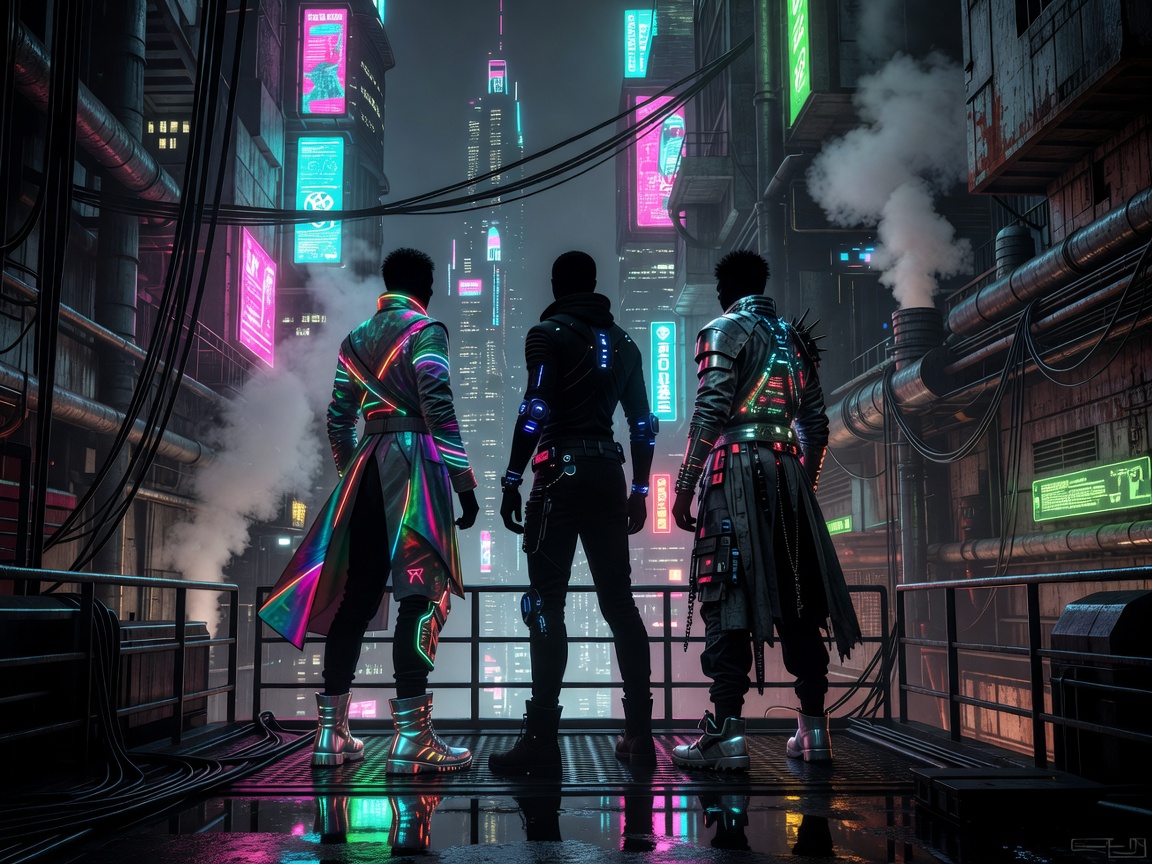
The city is layered, not merely dark
Cyberpunk environments mix incompatible systems: old masonry under new screens, improvised wiring around corporate infrastructure, street trade beneath automated transport. The visual density suggests that the future did not replace the past cleanly. It accumulated on top of it. Repairs, adaptations and unofficial uses remain visible.
Neon works because it is commercial light. It marks businesses, advertisements, entertainment and services. Reflections multiply those messages across wet or polished surfaces, making private commerce occupy public vision. Use neon alone and the result is colourful nightlife. Add scale, clutter, restricted access and surveillance, and the image begins to carry cyberpunk pressure.
Fashion starts with function and modification
Cyberpunk clothing often combines protective outerwear, workwear, sportswear, tactical references and conspicuous technology. Layers imply uncertain weather, mobility and the need to carry equipment. Fastenings, pockets, reinforced panels and modular attachments communicate use. Reflective or luminous accents connect the body to traffic and signage.
The weak version treats tactical detail as decoration detached from purpose. The stronger version asks where the wearer travels, what they carry and which systems recognise them. A courier, corporate operative, club performer and street technician should not share one universal outfit. Class, labour and access shape the silhouette.
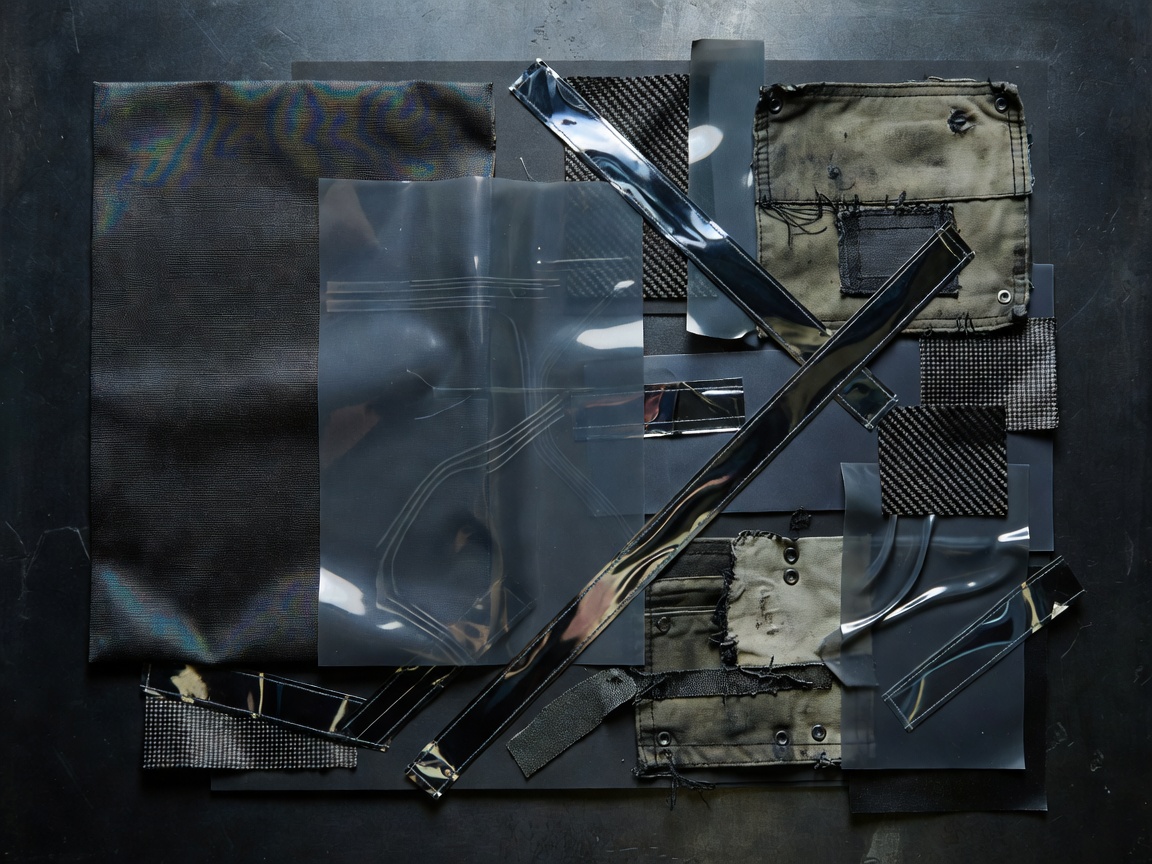
Interfaces reveal institutional attitudes
Cyberpunk interfaces range from tactile keyboards and exposed cabling to augmented overlays and seamless corporate displays. The contrast matters. Rough interfaces suggest maintenance, limits and user knowledge. Invisible systems suggest privilege or control. A screen crowded with warnings may indicate complexity, but unreadable decoration quickly turns into visual noise.
Good interface design establishes hierarchy. It shows what the user needs, what the institution wants and what remains hidden. Identity status, access level, location tracking and commercial prompts can place power directly in the frame. Glitches are most effective when they indicate conflict between systems rather than serving as a compulsory transition effect.
Music builds the pressure field
Cyberpunk sound pulls from electronic music, industrial textures, ambient soundscapes, synth-driven scoring, breakbeats and club forms. There is no single mandatory genre. The shared quality is tension between machinery and human rhythm. Repetition can suggest infrastructure; distortion can make that infrastructure unstable; spacious ambience can render the city vast and isolating.
Context decides whether a sound reads as cyberpunk. A synthesiser does not carry politics by itself. Pair the music with systems of labour, surveillance, nightlife, mobility or resistance. Diegetic sound—the music and noise characters can hear—helps situate culture inside the world instead of coating it from outside.
The recurring power structure
Corporations in cyberpunk often perform roles associated with governments: policing, housing, healthcare, military force, identity systems and communications. The point is not simply that a company is villainous. It is that essential infrastructure is organised around private control, making refusal difficult. Characters may dislike the system and still depend on its clinics, networks or wages.
Surveillance turns that dependency into visibility. Cameras are only one layer. Transaction records, biometric identity, location data, workplace monitoring and predictive systems can all narrow the space for anonymous action. The classic hacker gains power by understanding those systems, yet also becomes intensely legible to them.
| Element | Surface reading | Deeper function |
|---|---|---|
| Neon signage | Colour and nightlife | Commerce occupying public space |
| Augmentation | Enhanced ability | Dependence, ownership and bodily autonomy |
| Dense interfaces | Technical complexity | Access, filtering and institutional control |
| Megatowers | Futuristic scale | Vertical hierarchy and protected distance |
Artificial intelligence and unstable personhood
Cyberpunk uses artificial intelligence to challenge ownership and moral status. A machine mind may be treated as property while displaying agency, or it may operate at a scale humans cannot interpret. The useful question is not merely whether it is conscious. Ask who built it, who defines its permissions, whose data formed it and who bears responsibility for its actions.
That inquiry loops back to human characters. If memories can be edited, personalities copied or bodies exchanged, legal and social identity becomes unstable. Wealth may buy continuity while everyone else rents access to themselves. The speculative device sharpens an old political question: who gets recognised as a person rather than a resource?
Rebellion without merchandising it
Cyberpunk rebellion is often improvised and compromised. Hackers, couriers, artists, criminals, workers and defectors exploit gaps in infrastructure. Their victories tend to be local because the systems are distributed and adaptive. This keeps resistance grounded in knowledge, solidarity and risk rather than destiny.
For design, writing or costume, begin with a pressure rather than a palette. Decide who controls transport, identity, medicine or communication. Then ask how people adapt materially. Patched clothing, counterfeit access, modified hardware and coded music should emerge from that relationship. Once the world has friction, the neon finally has something to illuminate.